Research Project

MFS-VQ-VAE: Synthesizing 7T-like MR Images from 1.5T MR Images with Prompt Attention in VQ-VAE

This project studies cross-field magnetic resonance image synthesis from 1.5T, 3T, and 7T MRI. The model aligns anatomical information in a shared vector-quantized latent space and uses target field prompts to generate controllable high-field-like images in a single step.

Research Focus
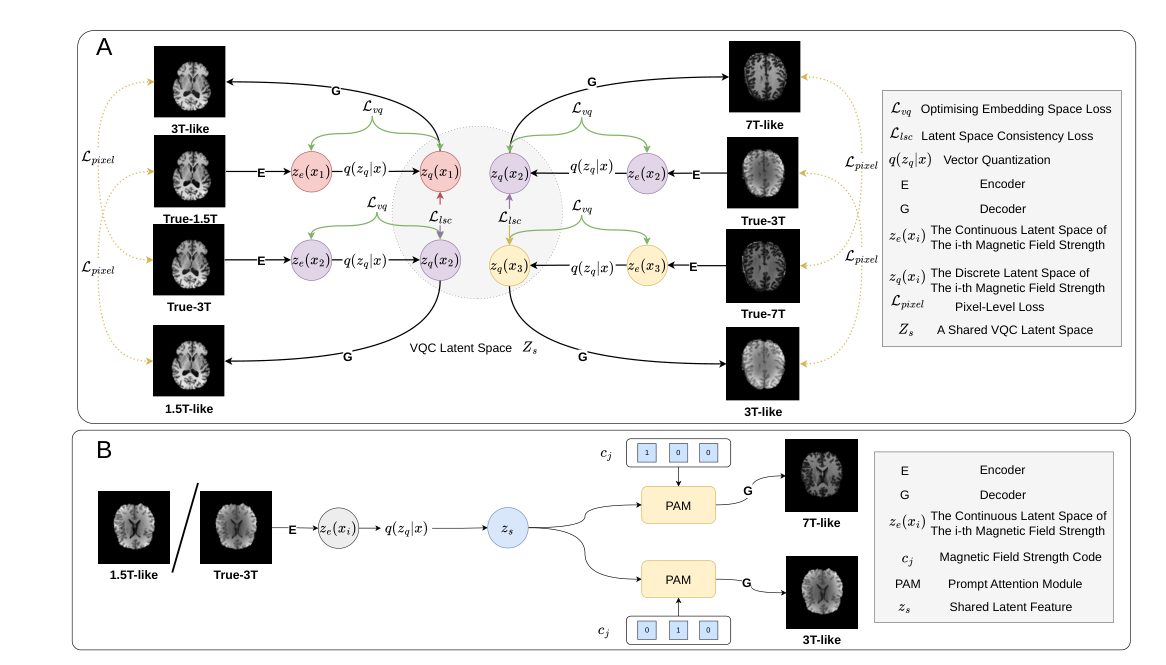
Shared VQC latent space

The model aligns 1.5T, 3T, and 7T anatomical structure inside one vector-quantized representation.

Prompt Attention Module

Target field codes guide the decoder so the same backbone can produce 3T or 7T-like outputs on demand.

Single-step enhancement

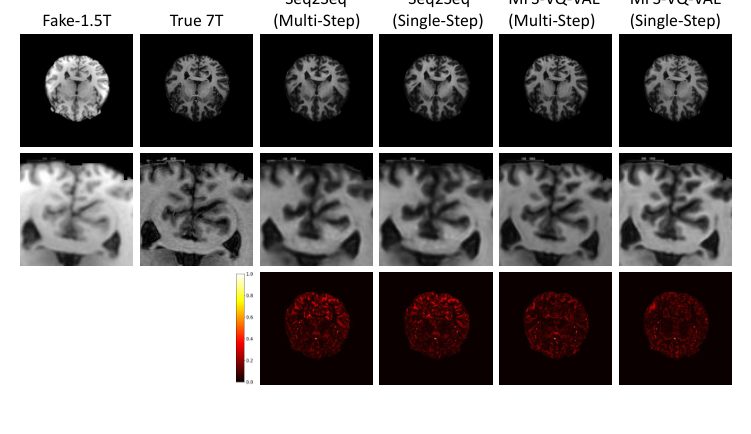
The restored figures below show why direct synthesis is more stable than multi-step field conversion.

1.5T input 3T bridge 7T-like output
Authors
XingHe Xie LuYi Han Yue Sun MengZhu Liu MingFeng Jiang HingChiu Chang Tao Tan*
Target Tasks
1.5T to 3T 3T to 7T 1.5T to 7T-like
Data
ADNI 1.5T/3T Public 3T/7T External validation
Keywords
VQ-VAE Prompt attention MRI synthesis Cross-field translation
Overview

One model for multi-field MR synthesis

7T MRI provides richer tissue contrast and finer structural detail, but scanners are less available and more expensive than 1.5T or 3T systems. MFS-VQ-VAE reduces this gap by learning a shared vector-quantized latent representation across multiple magnetic field strengths.

The attached page centered on the idea of controllable synthesis with Prompt Attention: once the source image is encoded into a shared latent space, a target field-strength code guides the decoder toward the desired output domain. This lets the model directly produce 3T or 7T-like images without relying on multi-stage cascades.

Method

VQ-VAE with target-field prompting

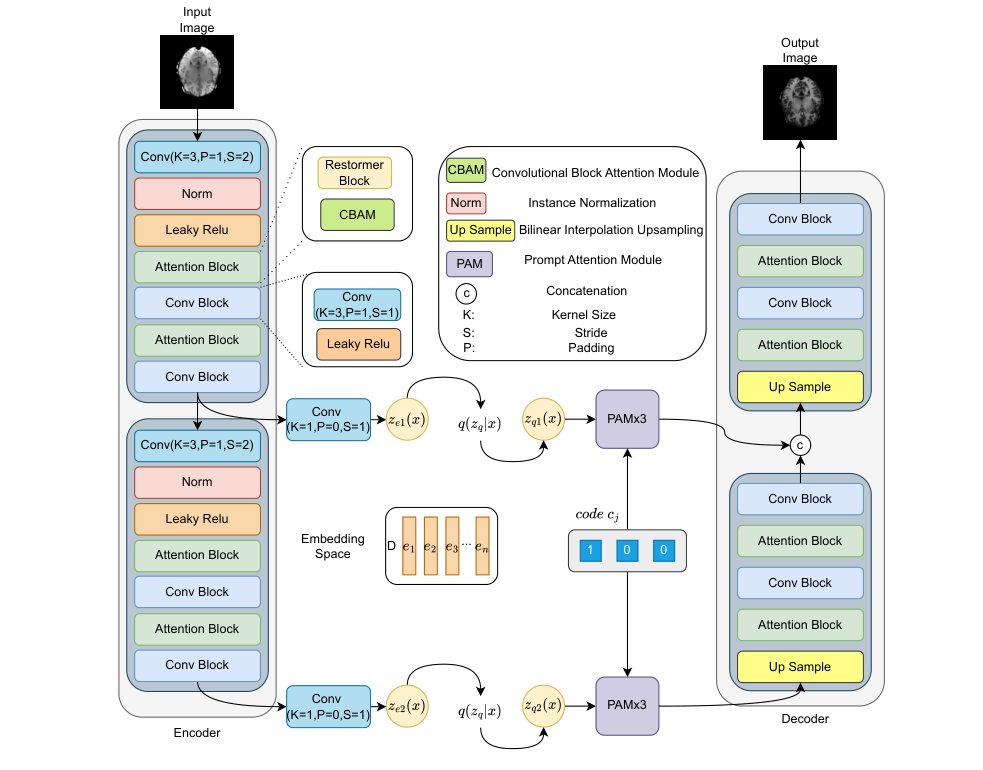
The encoder first maps the source MRI into a continuous latent feature. Vector quantization then projects it into a shared codebook space, and the Prompt Attention Module conditions that representation with the target field code before decoding the final synthesized image.

Input MRI
1.5T, 3T, or 7T source image
Shared VQC latent
Field-invariant anatomical representation learned across domains
PAM plus decoder
Target code guides the model toward 3T or 7T-like reconstruction
i→j = G(PAM(zq(xi), cj)),   i, j ∈ {1.5T, 3T, 7T},   i ≠ j.
The target field code cj controls whether the decoder reconstructs a 3T or 7T-like image.
Shared VQC latent space construction figure

Shared VQC latent space construction: joint 1.5T to 3T and 3T to 7T synthesis constrains multi-field latent vectors into a unified representation space.

MFS-VQ-VAE architecture

MFS-VQ-VAE architecture: encoder, vector quantization, Prompt Attention Module, and decoder for target-field reconstruction.

Field-aware control. Prompt Attention introduces an explicit magnetic field-strength condition into generation, so the same latent representation can be decoded toward different target domains.

Cross-domain alignment. The VQ codebook encourages a shared anatomical basis while preserving enough flexibility for domain-specific appearance and contrast reconstruction.

Results

Quantitative performance

The original attached page included interactive task switching for metrics. That interaction is preserved here while matching the site's Research page visual system.

Task SSIM PSNR LPIPS Sharpness
MFS-VQ-VAE - 1.5T to 3T 0.973 +/- 0.006 32.4 +/- 1.7 1.7 +/- 0.4 -
MFS-VQ-VAE - 3T to 7T 0.927 +/- 0.005 28.6 +/- 0.6 5.7 +/- 0.4 1.90 +/- 0.23
Single-step 1.5T-like to 7T - Group T 0.931 +/- 0.013 27.8 +/- 1.1 6.4 +/- 1.0 2.31 +/- 0.04
External validation - 3T to 7T 0.871 +/- 0.002 25.2 +/- 1.0 23.1 +/- 3.4 -

The table values are carried over from the attached standalone page and reorganized into the current site style.

Visual Comparison

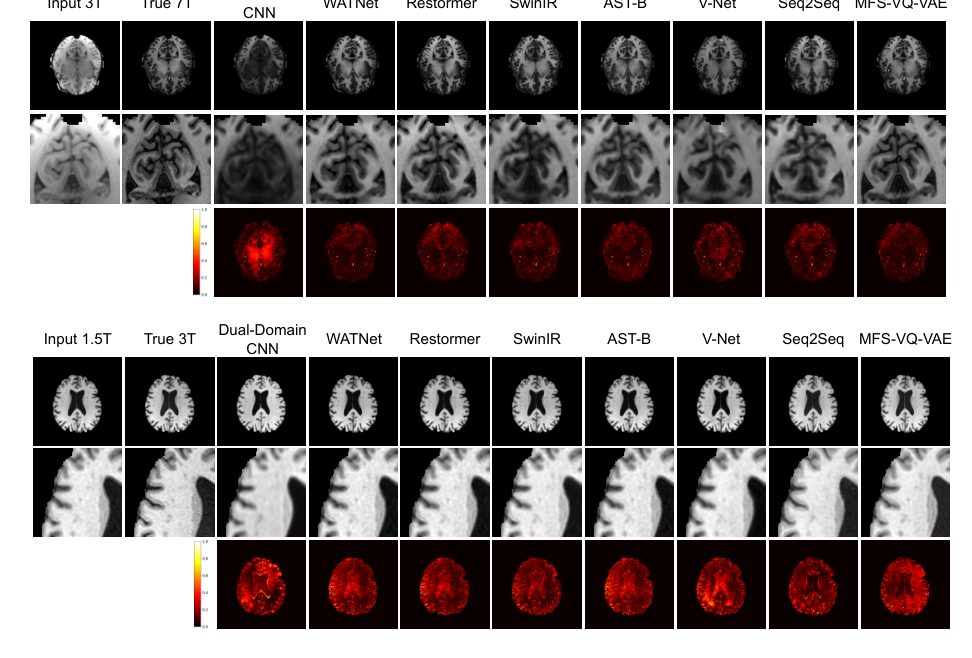
Better structure and fewer synthesis errors

Prediction error maps and visual comparison

Visual comparisons and error maps for 1.5T to 3T and 3T to 7T synthesis against representative baselines.

The restored visual set shows that the proposed model preserves anatomical detail more faithfully while reducing prediction error compared with representative baselines.

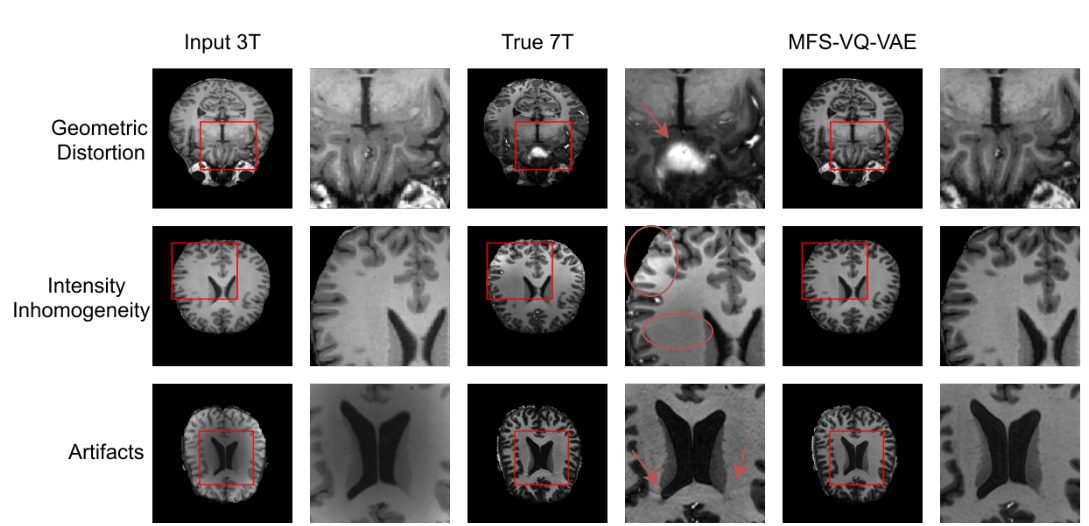
It also highlights why direct 1.5T-like to 7T synthesis is preferable to cascaded conversion, and how 7T-like outputs help suppress distortion and intensity inhomogeneity.

All figures from the original standalone HTML have now been extracted into the local `Xiexinghe_research` asset directory and reconnected here.
Single-step and multi-step comparison

Single-step synthesis avoids cumulative degradation compared with multi-step 1.5T-like to 3T to 7T synthesis.

Magnetic field inhomogeneity correction

7T-like synthesis from 3T MRI can reduce artifacts, geometric distortion, and intensity inhomogeneity while retaining high-field contrast.

Data and Evaluation

Training, validation, and metrics

ADNI 1.5T/3T
70 paired T1-weighted MPRAGE samples for low-to-standard field synthesis.
Public 3T/7T
30 paired T1-weighted MPRAGE samples including training and external validation data.
Evaluation
PSNR, SSIM, LPIPS, perceptual distance, and hippocampal ROI sharpness.
Citation

BibTeX

You can copy the current BibTeX entry below and update the venue field when the publication details are finalized.

@article{xie2025mfsvqvae,
  title   = {MFS-VQ-VAE: Synthesizing 7T-like MR Images from 1.5T MR Images with Prompt Attention in VQ-VAE},
  author  = {Xie, XingHe and Han, LuYi and Sun, Yue and Liu, MengZhu and Jiang, MingFeng and Chang, HingChiu and Tan, Tao},
  journal = {IEEE Transactions and Journals},
  year    = {2025},
  note    = {Update venue information after publication}
}