Many laboratory achievements were published in international top journals: promoting trusted medical imaging AI to clinical practice
Our laboratory has recently published a number of research papers in a number of internationally renowned journals, focusing on the latest progress of the team in medical imaging AI, computational oncology and clinical transformation. The research covers long-term prognosis prediction of breast cancer, whole-body PET-CT breast cancer segmentation, MRI leading method for radiotherapy process, and robust segmentation of brain tumors under complex clinical conditions, reflecting the research concept of continuous promotion of closed-loop "method innovation clinical value landing application" in the laboratory.
Recent representative achievements:
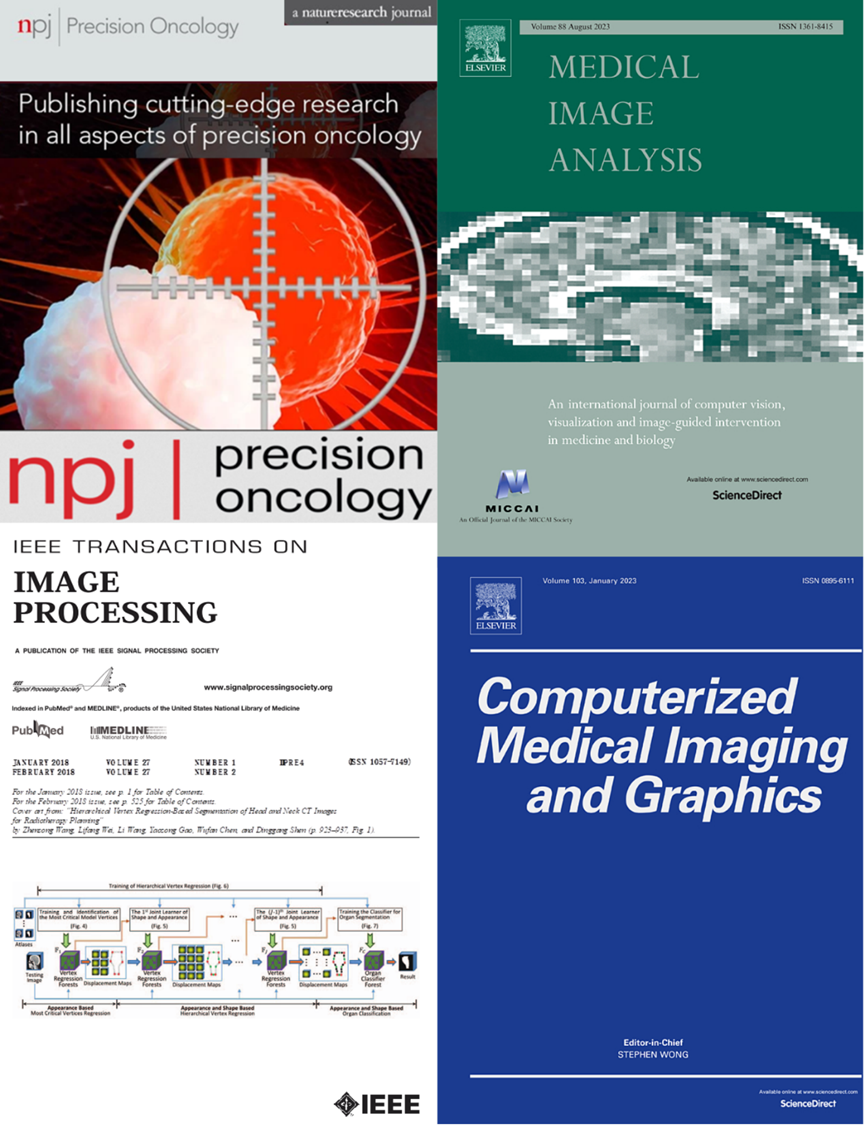
- “Multi-Omics Deep Learning Improves FDG PET-CT-based Long-term Prognostication of Breast Cancer” npj precision oncology
This study advances long-term outcome prediction for breast cancer by integrating multi-omics information with FDG PET-CT signals through deep learning, aiming to support more personalized risk stratification and follow-up planning. - “Anatomy-guided Prompting with Cross-Modal Self-Alignment for Whole-body PET-CT Breast Cancer Segmentation” Medical Image Analysis
We propose an anatomy-guided prompting framework with cross-modal self-alignment to improve whole-body PET-CT segmentation for breast cancer, enhancing robustness and consistency across modalities and anatomical contexts. - “Anatomy-aware MR-imaging-only Radiotherapy” IEEE Transactions on Image Processing (T-IP)
This work explores anatomy-aware strategies for MR-imaging-only radiotherapy workflows, helping reduce reliance on additional modalities while strengthening anatomical fidelity for treatment-related imaging tasks. - “SGAFNet: Robust Brain Tumor Segmentation via Learnable Sequence-Guided Adaptive Fusion in Available MRI Acquisitions” Computerized Medical Imaging and Graphics
SGAFNet introduces learnable sequence-guided adaptive fusion to handle variable MRI acquisition availability, delivering more robust brain tumor segmentation under real-world clinical constraints.
We will continue to push forward on foundation models for medical imaging, cross-modal alignment, and clinically grounded evaluation—working toward AI systems that are not only accurate, but also reliable, generalizable, and ready for real-world decision support.